What Are the Best Flat Roof Materials for Katy Weather?
Choosing flat roof materials for Katy's heat, humidity and storms? Compare TPO, EPDM, PVC and modified bitumen on cost, lifespan and performance.
Last Updated: November 5, 2026
Quick Summary
The best flat roof materials for Katy weather are TPO, EPDM, PVC, and modified bitumen, each handling heat, humidity, and storm risk differently. TPO offers energy efficiency at the lowest single-ply price, EPDM leads membrane lifespan at 30+ years, PVC delivers premium puncture resistance, and modified bitumen suits tight budgets and foot traffic.
- Flat roofing materials run about $5.50 to $7.50 per square foot nationally, per RubyHome benchmarks.
- TPO's heat-welded seams resist humidity-driven leaks better than adhesive seams, but seam failure is its top problem.
- Spray polyurethane foam holds the longevity crown at over 50 years with proper maintenance.
- Ponding water stresses seams and adds load, so correct slope, scuppers, and clear drains come first.
- Confirm in writing whether your policy covers windstorm, hail, and long-term water damage.
Table of Contents
- Flat Roof Materials and Katy's Heat, Humidity and Storm Risk
- TPO Roofing Material: The Default Choice for Low-Slope Roofs
- EPDM Roofing: Rubber That Handles Heat and Temperature Swings
- PVC and Modified Bitumen: Premium and Budget Alternatives
- The Longest Lasting Flat Roof Material Depends on Maintenance
- Flat Roof Material Cost: What Drives the Price Up or Down
- Drainage, Ponding Water and Insurance Rules That Decide Performance
- Get a Free Flat Roof Inspection and Written Findings
- Frequently Asked Questions
Flat Roof Materials and Katy's Heat, Humidity and Storm Risk
Choosing the best flat roof materials for Katy weather comes down to four candidates: TPO, EPDM, PVC, and modified bitumen. Each handles the area's triple threat differently. Katy, TX sits in a climate that punishes flat roofs from three directions at once: summer heat that bakes membranes, humidity that finds every seam, and hurricane-season wind that tests every fastener. The best flat roof materials for Katy weather are the ones that resist all three, not just the one your contractor happens to stock.
This guide from Roof Repair Company breaks down each material on cost, lifespan, and real performance under Gulf Coast conditions. For deeper material comparisons, browse the roofing materials articles on our blog. Flat roofing materials run about $5.50 to $7.50 per square foot nationally, according to RubyHome's flat roofing cost benchmarks, so the gap between a budget membrane and a premium one is real money across a full roof.
Below, we rank the four main options and explain what actually decides how long each one lasts here.
TPO Roofing Material: The Default Choice for Low-Slope Roofs
TPO, or thermoplastic polyolefin, is a single-ply reflective membrane and the most common choice for low-slope roofs on commercial and residential buildings, per RoofVista's low-slope roofing overview. Its white surface reflects sunlight, which matters in a climate where attic heat drives cooling bills.
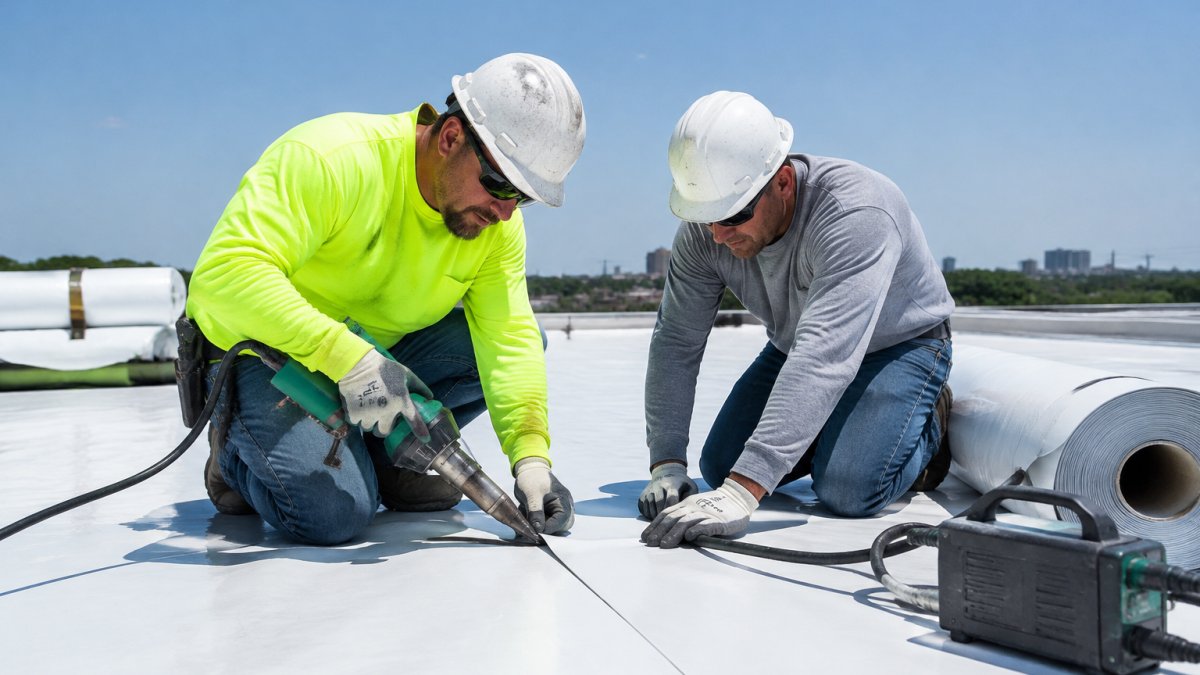 Roofers heat-welding a TPO membrane seam on a project using flat roof materials under the bright Texas sun.
Heat-welded seams create a watertight bond that resists humidity-driven leaks better than adhesive seams. TPO also stands up to mold, dirt, and punctures. The catch: seam failure is the top cause of TPO problems, and it almost always traces back to sloppy installation. For homeowners near Town Center, our Town Center, The Woodlands roofing page covers TPO and party-wall flashing as a complete assembly.
Best for: Homeowners who want energy efficiency at the lowest single-ply price. Skip if: You're hiring on price alone and the installer can't prove seam-welding experience.
EPDM Roofing: Rubber That Handles Heat and Temperature Swings
EPDM roofing is a synthetic rubber membrane built for longevity. It resists ozone, weathering, and abrasion, and it is lightweight and conforms to odd roof shapes.
The knock against EPDM in Katy is color. Standard black rubber absorbs heat, which pushes cooling loads up in July and August. Reflective coatings help, but they add a maintenance line item. If you want rubber's durability without the heat penalty, ask about white EPDM or a coated system.
Best for: Property owners prioritizing long-term durability over energy savings. Skip if: Cooling costs are your main concern and you won't coat the membrane.
PVC and Modified Bitumen: Premium and Budget Alternatives
PVC is a thermoplastic membrane generally considered a premium option, with a monolithic surface formed by heat-welded seams. The trade-offs are cost and cold-weather stiffness, which matters less in Katy than in northern climates.
Modified bitumen is the budget workhorse: an asphalt-based, polymer-reinforced multi-layer system that shrugs off foot traffic. It installs by torch-down or peel-and-stick.
| Material | Relative Cost | Lifespan | Best For |
|---|---|---|---|
| TPO | Lowest single-ply | 20-30 years | Energy efficiency on a budget |
| EPDM | Mid-range | 30+ years | Durability, simple repairs |
| PVC | Highest | 20-30 years | Maximum puncture and chemical resistance |
| Modified bitumen | Budget | 15-20 years | High foot traffic, tight budgets |
The Longest Lasting Flat Roof Material Depends on Maintenance
Spray polyurethane foam holds the longevity crown at over 50 years with proper maintenance, according to American WeatherStar's flat roof performance guide. Among membrane systems, EPDM leads at 30+ years.
But lifespan is a maintenance story, not a product label. Ponding water, clogged drains, and skipped inspections kill roofs early regardless of material. If your substrate or underlayment is failing, see our guide to roof decking and underlayment replacement costs in Katy before you price a new membrane.
Flat Roof Material Cost: What Drives the Price Up or Down
Flat roof material cost depends on membrane type, roof size, substrate condition, insulation, drainage work, and the details around penetrations and edges. Material alone runs about $5.50 to $7.50 per square foot nationally, according to RubyHome's flat roofing cost benchmarks, but that figure is only the membrane. On a full Katy replacement, labor, tear-off, flashing, and disposal usually meet or exceed the material line, so the installed price per square foot is the number that matters when you compare bids.
The material choice itself moves the number in predictable ways. TPO is typically the lowest-cost single-ply membrane, which is a large part of why it dominates low-slope roofs. EPDM sits in the middle and often wins on simple repairs because patches are straightforward. PVC is the highest of the three single-ply options, reflecting its tensile strength and chemical resistance. Modified bitumen is a lower-cost option, though its service life should be weighed against its upfront price.
The biggest cost swing is what is underneath. A sound deck means a straightforward install; a wet, rotted substrate means tear-off, deck repair, and possibly new insulation before any membrane goes down. Insulation thickness and R-value also change the price, and in Katy's climate the insulation layer is doing real work against cooling loads. Drainage corrections, adding slope, replacing drains, or installing scuppers, are another line that shows up on good bids and disappears from cheap ones.
Get a written scope before comparing bids. The scope should list membrane type and thickness, insulation, flashing details, tear-off, disposal, and drainage work, so the per-square-foot numbers you compare are actually for the same job.
Drainage, Ponding Water and Insurance Rules That Decide Performance
Ponding water is the quiet killer of flat roofs, and in Katy it is not a hypothetical. The Gulf Coast rain pattern delivers intense storms that overwhelm undersized drains, and a flat roof with marginal slope can hold water for days. Standing water over an extended period can stress seams and add load the structure was not designed to carry. Proper slope, correctly sized scuppers, and clear drains prevent it, and the material choice affects how forgiving the assembly is when water does linger.
TPO and PVC are heat-welded into a monolithic surface, so a properly welded seam is less likely to wick water than an adhesive seam. EPDM is durable but relies on adhesive splices and sealant at details, which is why ponding water tends to find EPDM seams first. Modified bitumen handles foot traffic well but has more laps and seams per square, giving water more places to enter. None of these materials fixes bad drainage; the drainage design has to be right first.
Insurance is the second half of the performance story, and it is where most national guides stop short. Windstorm coverage is not automatic in every policy, and homeowners should confirm in writing whether their policy covers windstorm, hail, and long-term water damage versus sudden storm damage. Your insurance provider or the official TWIA resources can confirm current coverage rules.
Claims for long-term water damage are often treated differently from sudden storm damage, so documentation can be important. A written inspection report with dated photos of drains, seams, and ponding protects you at claim time. Our team provides insurance claim assistance and on-site adjuster meetings for exactly this reason.
Watch out: a roof that ponds after every heavy rain is a drainage problem, not a membrane problem, and replacing the membrane without correcting slope and drains usually reproduces the same failure within a few seasons.
Get a Free Flat Roof Inspection and Written Findings
Katy's heat, humidity, and storm risk reward the homeowner who picks the right membrane and maintains it. TPO for efficiency, EPDM for durability, PVC for toughness, modified bitumen for budget: the best flat roof materials for Katy weather are the ones matched to your roof and your plan.
Roof Repair Company offers free storm and hail damage inspections, satellite-based roof measurement, and a written summary of findings for claims. No salesman, no pressure. Get started with Roof Repair Company and get instant online pricing in 60 seconds.
Frequently Asked Questions
What is the most durable material for flat roofing?
Service life varies by material, and maintenance plays a large role in how long any flat roof lasts. Durability depends as much on installation quality and drainage as on the material itself. A membrane installed over a wet substrate or a roof that holds ponding water will fail early no matter which product you choose.
Is TPO or EPDM better for a flat roof in Texas?
TPO has a reflective white surface, which many homeowners choose for summer heat. EPDM is typically darker and absorbs more heat, but it resists ozone and weathering well. If cooling cost is the priority, pick TPO. If you want the longest membrane life and can accept higher summer heat gain, EPDM is a solid pick. Both need heat-welded or properly sealed seams done by a professional.
How long do flat roof materials last in the Houston area?
Actual lifespan depends on the material, installation quality, and maintenance. Heat, humidity and hurricane-season wind are the main lifespan limiters, so wind uplift resistance and seam integrity matter as much as the material label. Regular inspections, clearing the drainage system and repairing flashing details early are what actually get a flat roof to the top of its rated range.
Which flat roofing material handles heavy rain and ponding water best?
PVC and TPO perform well against standing water because their heat-welded seams form a continuous membrane with strong puncture and tear resistance. Modified bitumen's multi-layer build also resists hydrostatic pressure when installed correctly. No material survives chronic ponding, though. Water that lingers after a storm usually points to a drainage problem, and fixing the roof pitch, drains and scuppers can matter more than switching materials. Ask for a drainage review with any flat roof quote.
<a href="https://roof.day">Free Inspection</a>
Need Professional Roof Replacement?
Roof Repair Company provides expert roof replacement services throughout Katy, TX. Contact us today for a free inspection and estimate.