Roofing Contractor Insurance Requirements: A Practical Guide
Roofing contractor insurance requirements explained: coverage types, minimum limits, Texas rules, and how to verify a roofer's certificate before you hire.
Last Updated: November 4, 2026
Quick Summary
Roofing contractor insurance requirements describe the minimum coverage a roofer must carry to protect your home, their crew, and their business. A standard general liability policy for roofing contractors should carry at least $1 million per occurrence and $2 million aggregate in 2026. Texas does not license roofing contractors statewide, so verifying roofing contractor insurance falls on the homeowner.
- Ask for a certificate of insurance and call the insurer to confirm the policy is active and limits match.
- A contractor who elects not to carry workers' compensation must disclose that in writing in Texas.
- In Texas, a roofer cannot act as a public insurance adjuster on a claim where they also do the repair work.
- A small roofing operation under $150,000 in revenue can start near $3,100 per year for basic GL.
- Confirm the policy expiration date falls after your project's completion date before signing.
Table of Contents
- What Roofing Contractor Insurance Requirements Actually Cover
- Minimum Coverage Limits and What Drives Premiums
- Texas Roofing Contractor Insurance Laws You Should Know
- How to Verify a Roofer's Insurance Certificate Before You Sign
- Roofing Insurance Claim Assistance in Katy: What to Expect
- What Happens When an Uninsured Roofer Damages Your Property
- Book a Free Inspection With a Registered, Certified and Insured Roofer
- Frequently Asked Questions
What Roofing Contractor Insurance Requirements Actually Cover
Roofing contractor insurance requirements describe the minimum coverage a roofer must carry to protect your home, their crew, and their business while working on your property. In Texas, a roofer working without general liability coverage can leave you holding the bill for damage. According to FCIS Group's 2026 guide to roofing contractor insurance, a standard general liability policy for roofing contractors should carry at least $1 million per occurrence and $2 million aggregate in 2026.
This guide from Roof Repair Company breaks down those requirements from a homeowner's point of view: what each policy covers and how to check a contractor's paperwork before anyone climbs a ladder. Below, we'll show you exactly what to look for on a certificate of insurance and where Katy homeowners get burned.
The Coverage Types That Matter Most
General liability insurance is the policy that pays when a roofing crew damages your home or injures someone on your property. It protects your wallet from the contractor's mistakes.
The other core policy is workers' compensation, which covers crew members injured on the job. Without it, an injured worker may come after you as the property owner. Most contracts between homeowners and roofers also reference commercial auto insurance for company vehicles and inland marine coverage for tools and equipment. A certificate of insurance is the document that proves all of this exists.
Minimum Coverage Limits and What Drives Premiums
There is no single statewide minimum for roofing contractor insurance in Texas, so the limits that apply to your project come from three places: the contract you sign, the permit-issuing city or county, and the requirements of any commercial client or lender involved. Limits on residential and commercial roofing jobs vary by contract, so check the requirements written into your own agreement. Workers' compensation limits are set by statute in Texas, and a contractor who elects not to carry it must disclose that in writing.
A practical way to read the limits on a certificate of insurance:
- General liability (GL): Confirm the per-occurrence and aggregate limits written into your contract.
- Products-completed operations: a separate aggregate, usually equal to the GL aggregate, that covers damage discovered after the crew leaves the property.
- Workers' compensation: Texas requires employers to carry it or file a notice of non-coverage with the Texas Department of Insurance. If a roofer has no policy, ask who pays if a crew member is hurt on your roof.
- Commercial auto: Confirm the combined single limit listed for company vehicles.
- Inland marine / tools and equipment: Limits are typically tied to the replacement value of the equipment.
- Umbrella or excess liability: An additional layer above the GL policy that some contractors carry for larger jobs.
What drives the premium up or down:
- Annual revenue and payroll. A small roofing operation with under $150,000 in revenue can start near $3,100 per year for a basic GL policy, according to Farmer Brown's 2026 cost analysis. As payroll grows, workers' compensation premium grows with it.
- Classification code and claim history. Roofing carries one of the highest workers' compensation rates in construction because of fall exposure. A clean loss history can cut the rate; a single serious claim can raise it for years.
- Deductible and aggregate choices. Raising the deductible lowers the premium but shifts more of each claim onto the contractor. Choosing a lower aggregate limit saves money but can leave a gap on a large loss.
- Subcontractor coverage. Uninsured subs push risk back onto the general contractor's policy. A contractor who requires every sub to carry their own GL and workers' comp pays less in the long run than one who absorbs that exposure.
- Territory and roof type. Hail-prone areas of Texas, including the Katy and greater Houston region, see higher property rates than low-storm regions, and steep-slope or tile work prices differently than flat commercial roofing.
Industry estimates put annual roofing contractor premiums anywhere from $8,000 to $250,000 or more depending on size and risk profile, per Grit Insurance's 2026 premium data. For a deeper look at materials, costs, and maintenance that affect your own roof, our Roofing Expert Blog covers the homeowner side.
Here are the coverage lines to check on a certificate and the factors that move a roofer's premium up or down.
| Item | Value or detail | Note |
|---|---|---|
| General liability minimum (2026) | $1 million per occurrence, $2 million aggregate | Standard policy benchmark |
| Products-completed operations | Separate aggregate, usually equal to GL aggregate | Covers damage found after crew leaves |
| Workers' compensation | Set by statute in Texas | Non-coverage must be disclosed in writing |
| Commercial auto | Combined single limit for company vehicles | Confirm limit on certificate |
| Inland marine | Tied to replacement value of equipment | Covers tools and equipment |
| Umbrella or excess liability | Additional layer above GL policy | Some contractors carry it for larger jobs |
| Small operation GL premium | Near $3,100 per year under $150,000 revenue | Basic GL policy |
| Annual premiums range | $8,000 to $250,000 or more | Depends on size and risk profile |
Texas Roofing Contractor Insurance Laws You Should Know
Texas does not license roofing contractors statewide, so verifying insurance falls on the homeowner. What Texas does regulate is how contractors interact with insurance claims and how employers handle workers' compensation.
Under Texas Department of Insurance rules, a roofing contractor cannot act as a public insurance adjuster on a claim where they are also performing the repair work. That separation exists to prevent a contractor from inflating a claim to pad their own invoice. If a roofer offers to "handle everything" with your insurer and do the repairs, that's a red flag in Texas.
Workers' compensation in Texas is not mandatory for every employer, but the rules still matter to a homeowner. An employer who chooses not to carry workers' compensation must file a notice of non-coverage with the Texas Department of Insurance and post it.
Local municipal permit requirements can add another layer of compliance, so ask your city or county which permits your project needs. A contractor who asks you to pull the permit as the homeowner is shifting compliance onto you, and that is worth questioning.
Watch out: a certificate of insurance that lists a policy expiration date before your project's completion date leaves you uncovered for the final weeks of the job, so confirm the policy will still be active when the crew finishes.
How to Verify a Roofer's Insurance Certificate Before You Sign
Ask for a certificate of insurance, then call the insurer listed on it to confirm the policy is active and the limits match. A certificate is only as good as the verification behind it.
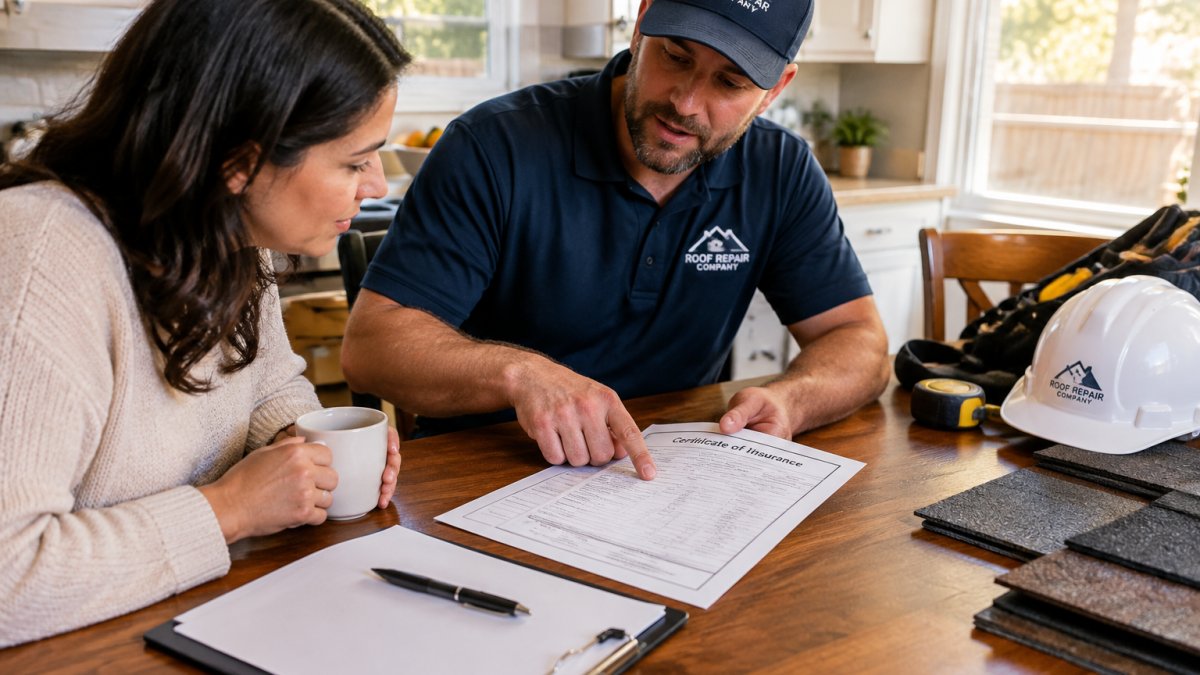 Homeowner and roofer reviewing a roofing contractor insurance certificate at a table
The man is American.
Use this checklist before signing:
- Certificate lists general liability limits that match your contract
- Workers' compensation policy is active for all employees
- Policy expiration date falls after your project's completion date
- Insurer's phone number is real and answers
- Contractor's legal business name matches the contract
- Subcontractors carry their own coverage
Pair this with a warranty comparison, since how to compare roofing contractor warranties matters just as much as the insurance check.
Roofing Insurance Claim Assistance in Katy: What to Expect
Roofing insurance claim assistance means the contractor documents damage, meets your adjuster on site, and gives you a written summary of findings to support the claim. It does not mean the contractor negotiates your settlement.
Here's what a legitimate process looks like:
- Free storm and hail damage inspection with photo documentation
- A written summary of findings you can submit to your insurer
- An on-site meeting between the contractor and your adjuster
- A scope review before any work begins
Roof Repair Company provides free storm and hail damage inspections, on-site adjuster meetings, and a written summary of findings for claims. For homeowners who want to read the fine print first, our in-depth insurance claims guides for Houston-area homeowners walk through the process step by step.
What Happens When an Uninsured Roofer Damages Your Property
When an uninsured roofer damages your property, your own homeowner's policy often becomes the fallback, and that can mean a claim on your record and a higher premium. The contractor's general liability policy exists precisely to prevent that outcome.
The stakes are real. Claim values in the roofing sector can be substantial, which is why comprehensive coverage matters. A contractor without workers' compensation creates a second problem: an injured crew member may pursue the property owner for medical costs.
If you're already dealing with storm damage and an unclear contractor situation, Jordan Ranch roof insurance claims and storm damage assistance explains how a free inspection and claim support can help you recover costs before small damage becomes a structural problem.
Book a Free Inspection With a Registered, Certified and Insured Roofer
The fastest way to confirm a roofer's insurance is to work with one whose credentials you can check before the first visit. Roof Repair Company is GAF Master Elite certified, registered, certified and insured, and has 1,122 customer reviews.
Our satellite-based roof measurement means you get instant online pricing in 60 seconds, with no salesman and no pressure. If you're in Katy or anywhere in the Greater Houston area and want an insured roofer to inspect your roof, expert roofing services for Cinco Ranch South and the surrounding area are one call away.
Get started with Roof Repair Company and book a free inspection to review your roof's condition and pricing.
Frequently Asked Questions
What type of insurance should a roofing contractor have?
At minimum, a roofing contractor should carry general liability insurance, typically starting at $1 million per occurrence and $2 million aggregate per FCIS Group's 2026 guidance. Workers' compensation is also essential, especially since roofing carries one of the highest workers' comp rates in construction, according to Grit Insurance. Commercial auto and inland marine coverage for equipment round out a complete policy. Ask for a certificate of insurance listing each policy and its limits before any work begins.
Does a roofing contractor need workers' compensation insurance in Texas?
Texas does not mandate workers' compensation for private employers, but that does not mean you should hire a roofer without it. If an uninsured worker is injured on your property, you could face liability exposure. Reputable contractors carry workers' comp voluntarily because commercial clients and municipal permits often require proof of coverage. Always request a certificate showing active workers' compensation before signing a contract, and confirm the policy covers roofing classification codes specifically.
How can I verify a roofing contractor's insurance certificate?
Request a certificate of insurance directly from the contractor and call the insurer listed on it to confirm the policy is active and the limits match. Check that your address or project is listed, that general liability and workers' compensation both appear, and that the expiration date covers your project timeline. In Texas, you can also cross-check the contractor's registration with the Texas Department of Insurance, which prohibits roofers from acting as public adjusters on claims where they also perform the repair work.
Is a roofing license required in Texas?
Texas does not issue a statewide roofing license, so licensing happens at the municipal level. Cities like Katy and others in the Greater Houston area require registration and proof of insurance, sometimes as low as $50,000 in general liability, before issuing permits. That makes verifying insurance even more important, since there is no state license to check. Ask for the certificate of insurance, confirm the contractor is registered locally, and look for manufacturer certifications like GAF Master Elite as an additional quality signal.
<a href="https://roof.day">Free Inspection</a>
Need Professional Roof Replacement?
Roof Repair Company provides expert roof replacement services throughout Katy, TX. Contact us today for a free inspection and estimate.