
Signs of Hail Damage on Shingles: 2026 Inspection Guide
Spot hail damage shingles fast with this 2026 guide: granule loss, dents, cracked shingles, plus safe inspection and insurance documentation steps.
Table of Contents
- What Hail Damage Looks Like on a Roof
- 7 Signs of Hail Damage on Shingles to Check After a Storm
- Hail Damage vs. Blistering on Shingles: How to Tell Them Apart
- How to Do a Safe Roof Hail Damage Inspection
- How to Document Roof Hail Damage for Insurance
- Repair or Replace? Judging Hail Damage Severity
- When to Call a Roofing Professional
- Frequently Asked Questions
Last Updated: October 17, 2026
What Hail Damage Looks Like on a Roof
Hail damage shingles show physical trauma from hailstone impact: granule loss, dark spots, bruised or cracked shingles, and dented metal roof components. At Roof Repair Company, we inspect storm-damaged roofs across Texas, and these are the patterns we look for first.
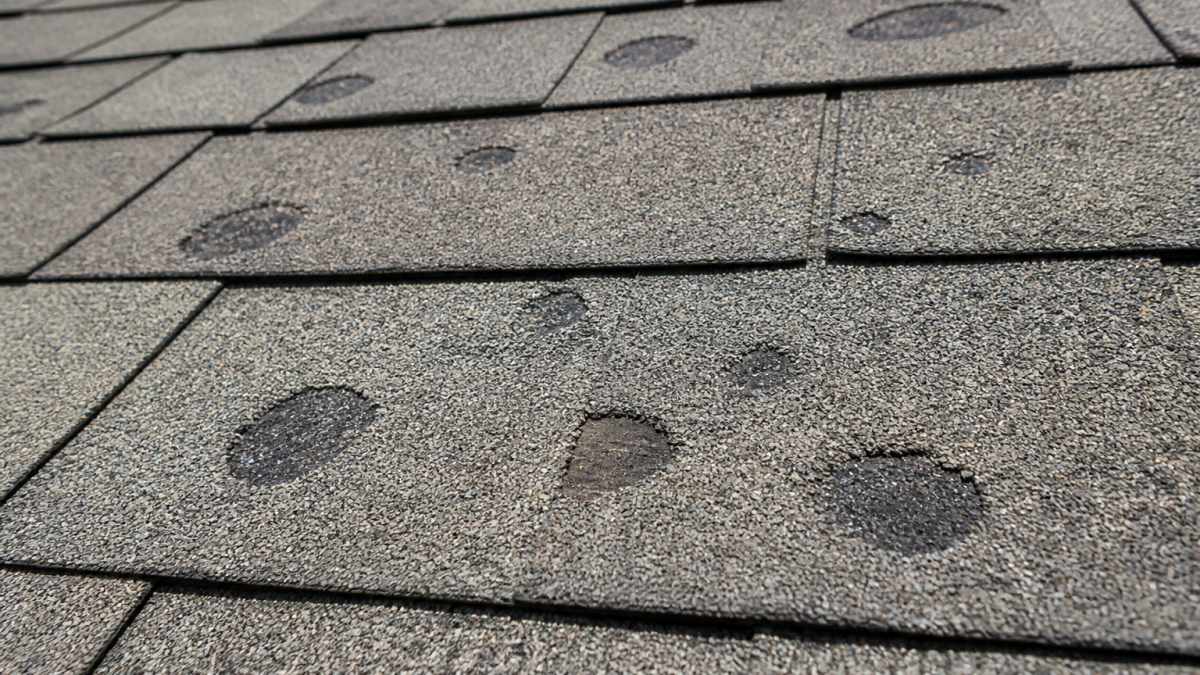 Close-up of an asphalt shingle roof surface showing scattered dark impact marks, exposed granule-free patches, and a few bruised shingles under bright daylight, viewed at a low angle
Granule Loss, Dark Spots, and Exposed Shingle Mat
Asphalt shingles wear a protective granule layer on top; hail knocks those granules loose on impact.
Here is what that looks like in practice:
- Dark spots where granules are gone and the asphalt underneath shows through
- Exposed shingle mat in severe strikes, where the fibrous base layer is visible
- Loose granules collecting in gutters, downspouts, and at the base of downpipes
Granule loss is often the first visible clue. A shingle that has shed its granules ages much faster, because the sun now hits the asphalt directly.
Bruises, Dents, Cracks, and Punctures in Shingles
A bruised shingle is soft to the touch and often darker than its neighbors; the impact crushes the internal structure without always breaking the surface.
Other impact types to check for:
- Dents with a shallow, rounded depression at the strike point
- Cracks radiating from an impact, sometimes only visible up close
- Punctures where a large stone broke clean through the shingle
These hail damage shingles problems most often turn into leaks, since a crack or puncture opens a direct path for water.
7 Signs of Hail Damage on Shingles to Check After a Storm
The seven signs of hail damage on shingles are granule loss, dark spots, bruised shingles, cracked or punctured shingles, loose or missing shingles, damage to roof components, and granules in gutters. Use this checklist after any hailstorm.
| Sign | What You'll See | Where to Look |
|---|---|---|
| Granule loss | Bare, dark patches on shingles | Slopes facing the storm |
| Bruising | Soft, dark spots that dent under light pressure | Field of the roof |
| Cracks and punctures | Split or holed shingles | Random scattered spots |
| Loose or missing shingles | Lifted, displaced, or absent tabs | Ridges, edges, slopes |
| Component damage | Dented vents, flashing, gutters | Roof penetrations and edges |
| Granules in gutters | Gritty buildup in gutters and downspouts | Gutters, downspouts, ground below |
| Random pattern | Impact marks spread unevenly | Whole roof surface |
FEMA guidance on inspecting roofs after storms
Loose, Lifted, Displaced, or Missing Shingles
Hail strikes can break the seal between shingle tabs; once it fails, wind gets under the shingle and lifts it.
Watch for:
- Shingle tabs that are lifted at the corners
- Shingles that look out of line or slid out of place
- Missing shingles altogether, especially after a storm with wind
Loose shingles are an open door for water and tend to tear free in the next windy storm.
Damage to Roof Vents, Flashing, Gutters, and Downspouts
Metal roof components show hail impact clearly, making them useful evidence. Dented vents, dinged flashing, and dimpled gutters are common signs of hail damage on a roof.
Check these areas:
- Roof vents for dents or cracked housings
- Flashing around chimneys, skylights, and walls for dents and lifted edges
- Gutters for dents, dings, and granule buildup
Damage here matters twice. It can leak on its own, and it helps document the storm's severity for an insurance claim.
Hail Damage vs. Blistering on Shingles: How to Tell Them Apart
Hail damage and blistering look similar at a glance but form differently and carry different weight with insurers. Hail impact leaves a random pattern of marks; blistering, foot traffic, and ordinary aging appear in more even, predictable spots. The skill is reading the pattern and the mechanism behind it.
Here is how to separate the lookalikes:
| Feature | Hail impact | Blistering | Foot traffic | Ordinary aging |
|---|---|---|---|---|
| Pattern | Random, scattered, no order | Clustered, often on sunny slopes | Linear, along walking paths | Even across the whole roof |
| Shape | Round or irregular bruise, sometimes with a dark center | Small raised or popped bubbles | Scuffs, worn granules, flattened areas | Curling, cracking, uniform granule loss |
| Feel | Soft, dents under light pressure | Brittle, pops or flakes | Firm, worn smooth | Brittle, edges curl |
| Location | Slopes facing the storm, ridges, edges | Sunny exposures, south and west slopes | Valleys, ridges, near roof penetrations | Everywhere, worst on oldest slopes |
| Timing | Appears after a known hail event | Develops over years | Gradual, tied to service visits | Gradual, tied to roof age |
How Each Lookalike Forms
- Hail impact crushes the shingle's internal structure at the strike point. The surface may stay intact while the mat underneath is fractured, which is why a bruise feels soft and looks darker than surrounding shingles. The mark appears where the stone landed, not where wear would concentrate.
- Blistering is a manufacturing or weathering phenomenon: trapped moisture or volatiles in the asphalt expand and pop the surface, leaving small raised or broken bubbles. It clusters where sun exposure is highest and runs in bands rather than scattering randomly.
- Foot traffic leaves scuffs and worn granules along paths a technician or previous roofer actually walked, usually in straight lines between penetrations, along ridges, or near the eaves.
What Adjusters Actually Look For
A common mistake is calling every dark spot hail damage. Adjusters look for the random pattern plus corroborating evidence: matching dents on metal components (vents, flashing, gutters, downspouts), granules in the gutters, and impact marks on other exterior surfaces at the same height. A tidy line of worn spots along a walking path is not hail, and neither is a cluster of popped bubbles on a sunny slope.
A Practical Diagnostic Sequence
- Establish the event. Confirm a hailstorm passed over the home and note the date and approximate hail size from local reports.
- Check the pattern. Random and scattered points toward hail; linear or clustered points toward wear or blistering.
- Check the metal. Dented vents, flashing, gutters, and downspouts are the strongest corroboration, metal dents from the same event are hard to explain any other way.
- Check the gutters. A heavy granule accumulation after the storm supports hail; gradual grit over years does not.
- Get a professional read. A roofer who inspects storm damage regularly can tell a fresh bruise from a blister in seconds, and will photograph the difference for your file.
How to Do a Safe Roof Hail Damage Inspection
A safe roof hail damage inspection starts from the ground with binoculars and only moves onto the roof when conditions are dry and safe.
The core rule: you inspect from the ground; a qualified roofer inspects on the roof. Your job is to gather evidence and decide whether a professional inspection is warranted, not to walk the field of the roof.
Ground-Level Checks Before You Ever Climb
Start with what you can see without a ladder, working the perimeter in a consistent direction so you do not miss a slope.
- Granules at downspout outlets. A gritty pile of sand-like granules where water exits is one of the most reliable ground-level clues. A sudden, heavy accumulation after a storm is the signal, versus the normal grit after heavy rain.
- Dents on gutters and downspouts. Aluminum gutters and downspouts dent visibly. Run your eyes along the top edge and the face of the gutter; dimples and dings are easy to spot in raking light.
- Dings on window screens, siding, and exterior fixtures. Torn or dimpled window screens, dented siding, and dinged AC condenser fins are strong corroborating evidence that hail reached the roof plane.
What ground checks cannot tell you: whether shingles in the middle of the field are bruised, whether the seal strips have failed, or whether the mat is exposed under a granule-free patch. Those require getting on the roof, which is a job for a professional with fall protection.
Why You Should Not Walk a Storm-Damaged Roof
A hail-damaged roof is not a normal roof with marks on it: impact can crush the shingle's internal structure and break tab seals without breaking the surface. Walking on it can:
- Turn a bruise into a crack or a crack into a puncture, creating a leak that did not exist before.
- Dislodge already-loose tabs, leaving the roof more vulnerable to the next wind event.
- Put you on a surface that looks intact but is soft, a bruised shingle can feel firm at the edge and give way underfoot.
Wet shingles, morning dew, and algae film make the surface slick even on a mild slope. If you must go up, limit it to a flat or very low-slope section you can reach safely, never walk the field of the roof, and never go alone.
What Hail Size and Storm Conditions Tell You
Hail about one inch across, roughly quarter size, is the common threshold where shingle damage becomes likely. Smaller stones usually bounce off. Larger stones and wind-driven hail do far more harm.
Storm conditions matter too:
- Wind direction decides which slopes take the hits, the slope facing the storm usually shows the most damage.
- Hail density and duration affect total damage; a long, dense storm can bruise an entire slope.
- Roof age and condition change how well shingles absorb impact. Older shingles lose granules faster and bruise more easily.
A roof near the end of its service life may show heavy damage from a storm that barely touched a newer roof. That is why the same hail event produces wildly different inspection results on the same street.
When Signs Are Subtle or Not Visible From the Ground
Absence of obvious marks does not prove the roof is undamaged. Some of the most consequential hail damage, bruised shingles in the field, failed seal strips, hairline cracks, is invisible from the yard. If a hailstorm passed over and you see any ground-level clues above, or your roof is older, the next step is a professional inspection, not a conclusion that the roof is fine.
FEMA guidance on inspecting roofs after storms
How to Document Roof Hail Damage for Insurance
Documenting roof hail damage for insurance means capturing clear photos, dates, and details before any repair work begins. Good documentation is the difference between a smooth claim and a fight.
Do this:
- Photograph each type of damage up close and from a wider angle for context
- Note the date of the storm and keep any weather reports
- Record hail size if you have it, from local reports or your own observation
At Roof Repair Company, our storm inspections include a written summary of findings you can hand straight to your insurer, plus on-site adjuster meetings and insurance claim assistance. That paperwork carries far more weight than a phone call alone.
Texas Department of Insurance homeowner claim guidance
Repair or Replace? Judging Hail Damage Severity
Repair usually makes sense for a few isolated strikes on a young roof; replacement is better when damage is widespread, shingles are old, or the roof has lost most of its granules.
Use these guidelines:
- Repair for a handful of bruised or cracked shingles on a roof under ten years old
- Replace when damage covers multiple slopes or hits most of the roof
- Replace when the roof is near the end of its service life anyway
The honest answer depends on the roof, not the sales pitch. A roofer who tells every homeowner they need a full replacement is worth a second opinion. So is one who patches a roof that is clearly failing.
When to Call a Roofing Professional
Call a roofing professional when you see any clear sign of hail damage, when you are unsure what you are looking at, or when your roof is older and you suspect hidden damage.
Reasons to call right away:
- Visible granule loss, dark spots, or exposed mat
- Bruised, cracked, or missing shingles
- Dented vents, flashing, or gutters
A professional inspection takes the guesswork out of it. Roof Repair Company offers free storm and hail damage inspections, uses satellite-based roof measurement, and provides instant online pricing in 60 seconds with no salesman involved.
Frequently Asked Questions
What does hail damage look like on asphalt shingles?
Look for random, uneven clusters of dark spots where protective granules have been knocked off, exposing the underlying mat. You may also see soft bruises that feel like a ripe melon when pressed, cracked or punctured shingle surfaces, and granules collecting in gutters and downspouts. Impact marks rarely follow a straight line; they scatter across slopes facing the storm. Damage often shows up on the same slopes that took the brunt of the wind, so compare one side of the roof against another before drawing conclusions.
Can hail damage shingles without causing a roof leak?
Yes. Most hail damage shingles take is cosmetic at first: granule loss and bruised shingle mat that has not yet opened a path for water. The problem is that exposed mat ages faster and bruises can crack later, so a leak may appear months after the hailstorm. That is why documentation matters even when the ceiling is dry. A roof hail damage inspection after the storm records the condition while the evidence is fresh, which supports an insurance claim later if a leak develops.
How do I document roof hail damage for insurance?
Photograph each damaged slope with a wide shot, then a close-up with a tape measure or coin for scale. Note the date, hail size, and which direction the storm came from. Keep a sample of granules from your gutters in a sealed bag, save receipts for emergency tarping, and write down anything the storm damaged besides the roof, such as window screens or siding. File the claim promptly and ask for an on-site adjuster meeting so findings can be compared side by side.
Should I inspect my roof myself after a hailstorm?
Do the ground-level checks yourself: scan gutters for granules, look for dents on downspouts and vents, check window screens and siding, and photograph anything suspicious. Leave the walking to a professional. Asphalt shingles bruised by hail can be brittle, and wet or steep slopes are a fall risk. A free professional inspection gives you a written summary of findings you can use for a claim, without you setting foot on the roof.
Hail damage rarely gets better on its own. Every storm that passes gives water another chance to get in. If you are not sure what you are seeing up there, get a free inspection from Roof Repair Company. We will document the damage, meet your adjuster on site, and give you a written summary for your claim. Get started with Roof Repair Company and protect your roof before the next storm hits.
<a href="https://roof.day">Free Inspection</a>
Need Professional Roof Replacement?
Roof Repair Company provides expert roof replacement services throughout Katy, TX. Contact us today for a free inspection and estimate.