7 Signs a Metal Roof Seam Is Leaking
Last Updated: November 3, 2026
Quick Summary
You can tell a metal roof seam is leaking by rust streaks or dark trails running down the seam, water stains on the ceiling or attic decking directly below a seam line, and dripping that starts within minutes of heavy rain. Loose fasteners, cracked or missing sealant, visible gaps between panels, and damp attic insulation are the other signs we look for.
- Two or more signs together is a strong case for a professional look.
- Check the attic on a dry day and follow water trails uphill toward the ridge.
- Run a controlled water test on one seam at a time with a garden hose on low pressure.
- Never pressure-wash a seam to test it, because high pressure can create a leak.
- Sealant is a short-term patch that lasts weeks to months, not a permanent fix.
Table of Contents
- 7 Signs a Metal Roof Seam Is Leaking
- How to Find a Leak in a Metal Roof: A Step-by-Step Inspection
- Metal Roof Leaking at Overlap: Why Seams Fail
- Why Metal Roof Leaks in Heavy Rain Show Up at Seams
- Telling a Seam Leak Apart From Other Roof Leaks
- Metal Roof Leak Repair Sealant: What Works and What Doesn't
- Stop the Drip Now: Temporary Fixes vs. Permanent Repair
- Book a Free Metal Roof Leak Inspection in Katy, TX
- Frequently Asked Questions
7 Signs a Metal Roof Seam Is Leaking
A metal roof seam is the folded or overlapped joint where two roof panels meet, and it is the most common place for a metal roof to leak. When you need to know how to tell if a metal roof seam is leaking, the signs usually show up in two places: on the panels themselves and on the ceiling below. The same handful of clues show up again and again on metal roofs.
Here are the seven signs we look for first:
- Rust streaks or dark trails running down a panel seam after rain.
- Water stains on the ceiling or attic decking directly below a seam line.
- Dripping during heavy rain that starts within minutes of a downpour.
- Loose or backed-out fasteners along the seam edge.
- Cracked, peeling, or missing sealant in the seam channel.
- Visible gaps or separation between overlapping panels.
- Damp insulation or musty smells in the attic near a seam.
One sign alone is a hint. Two or more together is a strong case for a professional look. For leaking seams, backed-out fasteners, panel damage, and corrosion, see metal roof repair in Houston.
How to Find a Leak in a Metal Roof: A Step-by-Step Inspection
Start inside, then work outward and upward. Most homeowners find the stain before they find the source, so the goal is to trace the water back to its entry point without turning a small seam leak into a fall injury or a bigger repair.
- Mark the interior stain. Note its position relative to a window, wall, or chimney, and measure how far it sits from the nearest exterior wall. That measurement is your first clue to which roof plane is involved.
- Check the attic on a dry day. Look for water trails, dark marks, and damp wood sheathing. Follow any trail uphill toward the ridge; water almost always enters higher than the stain appears.
- Match the attic trail to a roof feature. Seams, penetrations, and flashing are the usual suspects. A trail that runs in a straight line usually points to a seam; a trail that fans out near a chimney or vent points to flashing or a penetration.
- Inspect from the ground with binoculars first. Look for rust lines, lifted panels, missing sealant, and backed-out fasteners along seam edges. This step alone resolves many suspected seam leaks without anyone climbing.
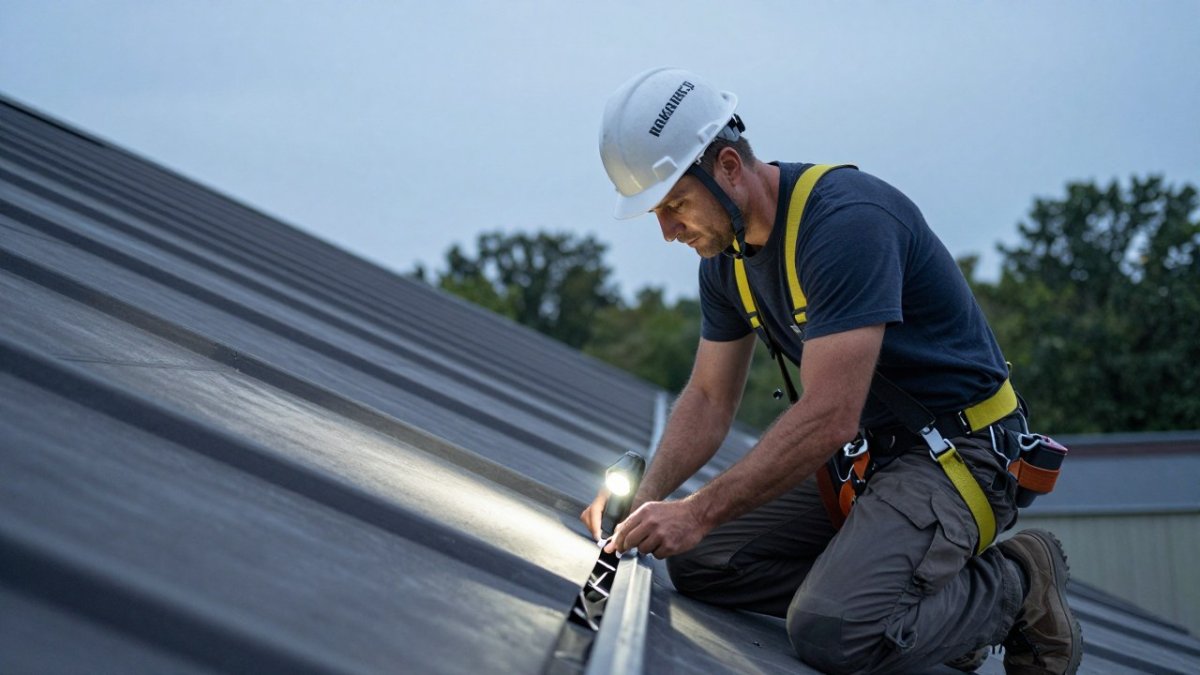
- Walk the roof only if it is dry and safe. Check each seam by hand for movement and gaps, and look for crushed or missing washers at fasteners. Wear shoes with grip, keep three points of contact, and stay off the roof if it is wet, windy, or steep.
- Run a controlled water test on one seam at a time. Have a helper on the roof spray a single seam with a garden hose on low pressure while you watch inside. Start at the lowest point of the seam and work uphill in short passes. Wait several minutes between passes so water has time to show up below.
- Photograph everything. Photos help with repairs, insurance claims, and warranty discussions.
For a deeper walkthrough of the full method, see our guide on how to find a roof leak in a house.
When Not to Climb on the Roof
Stay off the roof in rain, wind, or when panels are wet. Metal gets slick fast, and a fall is far worse than a leak. Skip the climb if you see sagging, loose panels, or storm damage. Call a pro instead.
Watch out: never pressure-wash a seam to test it. High pressure drives water sideways past the seam and can create a leak that was not there, which sends you chasing the wrong repair.
How to Run a Controlled Water Test Without Making Things Worse
A controlled test is the most reliable way to confirm a suspected seam leak, but it only works if you isolate one variable at a time. Use a helper on the roof and a second person inside with a flashlight. Spray one seam only, from the bottom of the run upward, and keep the nozzle moving so water does not pool against the seam. If nothing shows inside after several passes, move to the next seam rather than soaking the first one longer.
Metal Roof Leaking at Overlap: Why Seams Fail
A metal roof leaking at the overlap almost always comes down to one of four failures: a failed fastener, a failed sealant, panel movement, or trapped water. Seams are designed to shed water, not sit in it. When any of those four break down, water finds the path.
The usual culprits:
- Overdriven screws that crush the rubber washer and leave a gap.
- Underdriven screws that never seal tight against the panel.
- Aged sealant that cracks and pulls away from the seam.
- Thermal movement that works fasteners loose over the seasons.
- Corrosion at cut edges and fastener heads.
Each one lets wind-driven rain push water under the overlap instead of over it.
Why Metal Roof Leaks in Heavy Rain Show Up at Seams
Metal roof leaks in heavy rain show up at seams because that is where the water volume and pressure are highest. A light drizzle may never reveal a small gap. A hard Texas downpour drives water sideways and forces it into any opening.
Storm-driven rain in the Houston area is intense and sudden, and it exposes weak seams. If your roof only leaks during big storms, the seam is a sensible place to check first.
Telling a Seam Leak Apart From Other Roof Leaks
A seam leak leaves a straight-line pattern. Other leaks leave different clues. That distinction saves you from patching the wrong spot, and it is the step most homeowners skip before buying sealant.
Use the pattern, the location, and the timing together:
- Seam leak: the water trail follows a panel seam line; the stain is narrow and linear, and it often appears or worsens within minutes of a hard rain. Rust streaks or dark trails running down the seam itself are a strong confirm.
- Flashing leak: water shows up near a chimney, wall, skylight, or valley. The stain tends to fan out rather than run in a line, and it may appear during wind-driven rain even when the seam stays dry.
- Penetration leak: damage clusters around a vent pipe, boot, or mounting bracket. The stain is usually a small circle or a drip point directly below the penetration.
- Fastener leak: small, isolated drip points along a screw line, often with a rust ring at the fastener head. This can look like a seam leak because fasteners sit at the seam edge, so check the washers before blaming the seam.
- Panel or hole leak: a puncture, hail dent, or damaged panel shows a stain that does not line up with any seam, flashing, or fastener.
If the stain sits near a chimney or wall, flashing is the more likely source. See roof flashing repair in Houston for chimney, wall, valley, and skylight leaks.
How to Confirm It Is the Seam and Not Something Else
The fastest confirmation is the controlled water test described above: isolate one seam, spray it, and watch inside. If the drip appears while that seam is being sprayed and stops when you move to the next seam, the seam is the source.
Watch out: sealant smeared over a seam that is actually a flashing leak will hide the real entry point and make the next inspection harder. Confirm the source before you patch anything.
Metal Roof Leak Repair Sealant: What Works and What Doesn't
Sealant is a patch, not a fix. It can slow a leak and buy you time, but it will not correct a loose fastener or a separated panel. Use it as a short-term step, not a permanent answer.
What works short-term:
- A quality metal-roof sealant rated for exterior use.
- A clean, dry surface before application.
- A thin, even bead pressed into the seam channel.
What fails fast:
- Sealant over a wet or dirty seam.
- Caulk smeared over a rusted or loose panel.
- Any patch that ignores the real cause.
Watch out: sealing a seam without fixing the loose fastener traps water and speeds up corrosion.
Stop the Drip Now: Temporary Fixes vs. Permanent Repair
Temporary fixes stop the drip. Permanent repair stops the leak. Know which one you are doing.
| Approach | What It Does | How Long It Lasts | Best For |
|---|---|---|---|
| Bucket and towel | Catches water inside | Hours | Buying time during a storm |
| Sealant patch | Slows water at the seam | Weeks to months | Short-term relief |
| Fastener replacement | Reseals the seam joint | Years | Loose or backed-out screws |
| Seam and panel repair | Fixes the root cause | Long term | Separated or damaged panels |
If temporary fixes keep failing, the seam needs a real repair. Roof Repair Company offers shingle and standing seam metal roof repair and insurance claim assistance when storm damage is involved.
Book a Free Metal Roof Leak Inspection in Katy, TX
You do not have to guess whether that stain is a seam leak or something else. A proper inspection settles it. Roof Repair Company offers free storm and hail damage inspections with a written summary of findings you can use for a claim.
If you are searching for metal roof leak repair near me in Katy, start with a free inspection and get the answer in writing. Book a free roof inspection and ask about available appointment times.
Frequently Asked Questions
Why is my metal roof leaking at the seams?
Seams fail for a few predictable reasons: fasteners back out or get overdriven and crush the rubber washer, seam sealant dries out and cracks, or panels expand and contract with heat until the overlap opens slightly. Wind-driven rain then pushes water into that gap. In Katy, TX, summer heat cycles and storm-driven rain speed this up, so a metal roof seam that held for years can start leaking after one bad storm season.
Can a metal roof seam leak show up far from the actual leak?
Yes, and it often does. Water entering at a panel seam can run along the roof decking, a purlin, or the underside of a panel before it drips through the ceiling. That means the water stain on your ceiling may be several feet from the real entry point. To find the source, trace the water trail backward in the attic and check uphill from the stain, not directly above it.
What should I check inside when I suspect a metal roof seam leak?
Start in the attic during or right after rain. Look for water stains, dark marks, or rust streaks on the wood sheathing, moisture on the underside of roof panels, and drips near the ridge or penetrations. Check that insulation isn't wet and that vents are dry. Take photos of anything you find, because that record helps an inspector or insurance adjuster confirm the leak source and scope.
When should I call a professional to inspect a leaking metal roof?
Call a pro if you can't safely get on the roof, if the leak appears after every heavy rain, if you see rust or corrosion along a seam, or if the stain keeps growing after you've sealed what looked like the source. Metal roof leak repair sealant is a temporary fix at best, and a failed seam usually needs fasteners or panels reset. A free inspection gives you a written summary of findings before you commit to any repair.
A leaking seam rarely fixes itself, and small drips turn into rotted decking and stained ceilings fast. Roof Repair Company provides standing seam metal roof repair across Katy and Greater Houston, backed by GAF Master Elite certification, written findings, and insurance claim assistance. Get started with Roof Repair Company and get your roof inspected before the next storm finds that seam.