7 Flat Roof Maintenance Schedule Steps for Texas Homes
Last Updated: November 10, 2026
Quick Summary
A flat roof maintenance schedule for Texas homes means two full inspections a year, one in spring and one in fall, plus a check after every major storm. Clean drains and scuppers quarterly, and inspect within one to two weeks after any hail or high wind.
- Schedule full roof inspections in March-April and October-November, twice yearly.
- Clean drains, scuppers, gutters, and downspouts quarterly and before forecast storms.
- Inspect within one to two weeks after hail or high wind.
- Treat water standing more than 48 hours after rain as a sign to call a roofer.
- Update your maintenance log the same day as each visit.
Table of Contents
- How Often to Inspect a Flat Roof in Texas
- Your Flat Roof Maintenance Checklist by Season
- Flat Roof Drainage Maintenance: Drains, Scuppers, and Gutters
- Flat Roof Maintenance After a Storm
- Membrane, Seam, and Flashing Checks by Roof Material
- Ponding Water: When to Escalate to a Roofing Pro
- Keeping Maintenance Records for Insurance and Warranty Claims
- Booking a Free Flat Roof Inspection
- Frequently Asked Questions
How Often to Inspect a Flat Roof in Texas
A flat roof maintenance schedule for Texas homes starts with two full inspections a year, one in spring and one in fall, plus a check after every major storm. A twice-yearly rhythm is a common baseline for low-slope roofs. This guide from Roof Repair Company covers the full schedule, from quarterly drainage cleaning to the records that support an insurance claim.
Texas weather makes the calendar matter more than in milder climates. Summer heat and UV break down membranes, spring hail and heavy rain test every seam, and fall is your window to fix what summer cooked before winter stresses it.
Here is the short version:
| Task | How Often | Best Timing |
|---|---|---|
| Full roof inspection | Twice yearly | March-April and October-November |
| Drain and scupper cleaning | Quarterly, plus before storms | Year-round |
| Post-storm inspection | After any hail or high wind | Within 1-2 weeks |
| Membrane and seam check | Twice yearly | During inspections |
| Record update | Every visit | Same day |
Below, we break down each step of the schedule so you know what to check and when to call a pro.
Your Flat Roof Maintenance Checklist by Season
Here is the month-by-month rhythm we recommend for a Katy home, built around local weather rather than a national template.
January to February: winter wet-season watch. Winter rains can leave water sitting on a roof that has not drained since fall.
March to April: spring hail and pollen recovery. Spring can bring hail and tree pollen, catkins, and leaf litter that clog drains quickly.
July to August: heat and UV stress check. This is the hardest stretch on a Texas flat roof.
September to October: fall preparation inspection. The fall inspection is your window to fix what summer cooked before winter rain stresses it.
One common mistake is treating the spring inspection as optional or pushing it into May.
Flat Roof Drainage Maintenance: Drains, Scuppers, and Gutters
Flat roof drainage maintenance is the single highest-value task on the schedule, because most flat roof leaks start at a blocked drain, not a failed membrane. Water has to leave the roof. Keeping drains clear prevents water from pooling, while recognizing how other weak points let moisture in helps complete the leak-prevention picture with United Roofing of Colorado.
Clean drains, scuppers, gutters, and downspouts quarterly, and always before a forecast storm.
What to check on each pass:
- Roof drains: clear the strainer and the drain body. Remove leaves, grit, and balled-up debris.
- Scuppers: confirm water can flow through the opening without pooling behind it.
- Gutters and downspouts: check for clogs and confirm water exits away from the foundation.
- Roof slope: water should move toward drains, not sit in low spots.
A common mistake is clearing the strainer but leaving the drain line clogged. Push water through and watch it exit; if it backs up, the line needs more than a surface clean.
Watch out: a drain that clogs repeatedly in the same spot often signals a slope problem, not a debris problem. That is a sign to bring in a roofer rather than keep clearing it.
Flat Roof Maintenance After a Storm
Flat roof maintenance after a storm means a focused inspection within a week or two, before small damage turns into a leak.
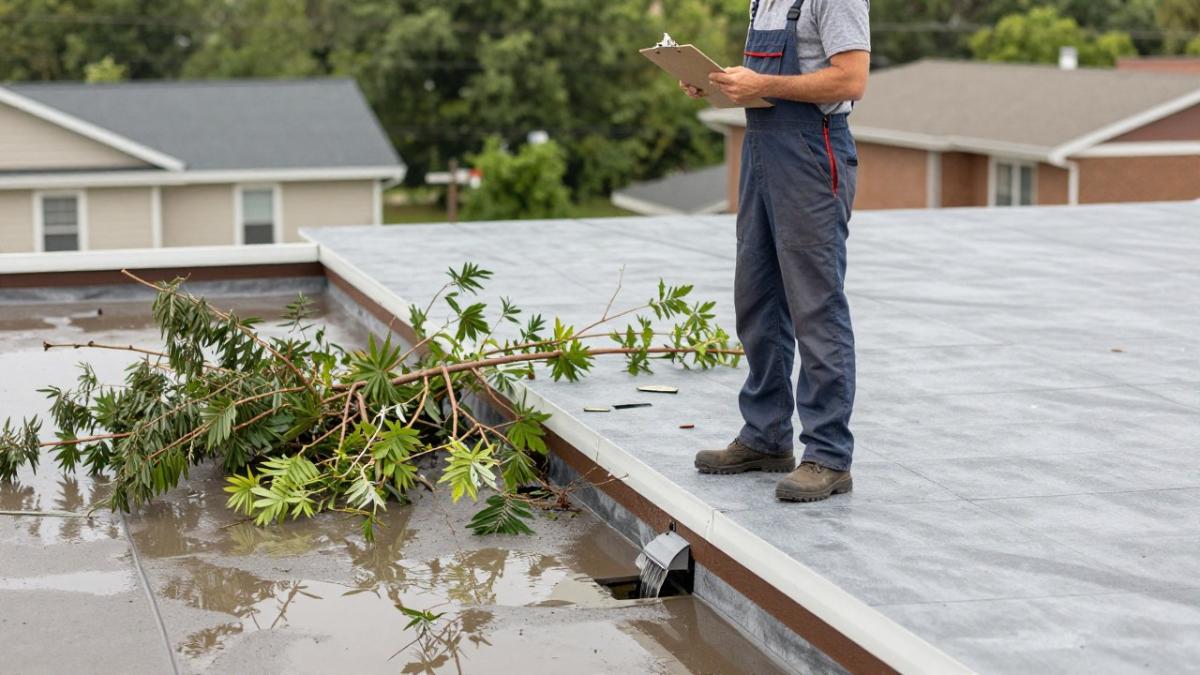
After a storm, check for:
- Dented or cracked membrane, especially on older built-up roofs
- Lifted seams and pulled flashing
- Punctures from wind-blown debris
- Standing water that did not drain within 48 hours
- Granule loss on modified bitumen surfaces
Do not walk a wet roof. Water hides soft spots, and a soft spot can be a hole waiting to happen. Inspect from the ground and from a safe edge, and call a pro for anything you cannot see safely.
If you are dealing with active damage, our guide on what to do first for emergency roof repair walks through the first steps.
For storm and hail damage, Roof Repair Company offers free inspections and a written summary of findings you can use for a claim.
Membrane, Seam, and Flashing Checks by Roof Material
Membrane, seam, and flashing checks differ by roof material, and using the wrong check wastes time. Each flat roof type fails in its own way. Know what you have before you inspect.
TPO and PVC single-ply: look for punctures, cuts, and separated seams. Seams are the weak point. Check every heat-welded seam for lifting.
EPDM rubber: watch for shrinkage, cracks at the edges, and seam separation. EPDM pulls back over time.
Modified bitumen: check for blisters, cracking, and granule loss. Blisters trap water and grow.
Built-up roofing: look for bare spots, blisters, and failed flashing.
Across all materials, check the same critical points:
- Seams and laps
- Flashing at walls and curbs
- Roof penetrations such as vents and pipes
- Roof edges and terminations
Resealing and caulking small gaps during an inspection is cheap. Ignoring them is not.
If you are weighing materials for a repair or replacement, our article on the best flat roof materials for Katy weather compares how each one holds up locally. And if you are looking at flashing specifically, our breakdown of whether flashing repair cost is worth paying helps you decide when to fix and when to escalate.
Ponding Water: When to Escalate to a Roofing Pro
Ponding water is standing water that remains on a flat roof more than 48 hours after rain stops. Water still standing after that point is a reasonable signal to have a roofer assess the roof.
The 48-hour figure is a rule of thumb, not a code requirement. A low-slope roof is designed to shed water, not hold it.
How ponding affects each roof material differently:
- TPO and PVC single-ply: the seams are the weak point. Standing water works into a seam that is already marginal and can lift it. Once water gets under the membrane, it travels and shows up far from the pond.
- EPDM rubber: ponding accelerates the shrinkage and seam separation EPDM is already prone to, and trapped water under a seam is hard to find until it leaks inside.
- Modified bitumen: standing water softens the asphalt and speeds granule loss, and it feeds blisters that trap water and grow.
- Built-up roofing: ponding saturates the plies and can lead to bare spots and failed flashing, and on older BUR systems it is often the first sign the surfacing has worn through.
How to tell whether you actually have ponding, and how to document it:
- Check the roof from a safe edge or from a window overlooking it after a rain, not by walking a wet roof.
- Note the time the rain stopped and the time the water was gone. If you cannot be there for both, take a photo with a timestamp when you first see standing water and another when it clears.
- Look for a ring of dirt or debris around a low spot. A dirt ring is a reliable sign that water pools there repeatedly, even if you have never seen it wet.
- Note whether the water returns to the same spot after every rain. A recurring low spot is a slope or drainage problem, not a one-time event.
When to escalate, in order:
- Water gone within 48 hours and no dirt ring: normal. Keep it on your inspection log and move on.
- Water still there at 48 hours, or a visible dirt ring: call a roofer for an assessment. This is the threshold where a simple drain clearing may no longer be the fix.
- Water returns to the same low spot every rain: this points to a slope or drainage design problem, and clearing the drain will not solve it.
- Soft spots or spongy areas underfoot, or sagging between supports: stop walking the roof and call a pro promptly. These are signs the deck underneath is compromised, and they are the clearest reason not to wait.
- Water stains on the ceiling below, or active dripping: treat it as an active leak and get a professional out quickly, because interior damage compounds fast in a Katy summer.
A roofer can tell the difference between a simple drainage blockage and a slope or structural problem. Clearing a drain fixes one; the other needs roof repair or restoration, and waiting makes it worse.
Watch out: do not walk a wet flat roof to check ponding depth. Water hides soft spots, and a soft spot can be a hole waiting to happen.
Keeping Maintenance Records for Insurance and Warranty Claims
Maintenance records prove you took care of the roof, and they carry real weight in an insurance or warranty claim. A dated log of inspections, cleanings, and repairs shows the damage came from a storm, not neglect.
Keep a simple folder, digital or paper, with:
- Date of each inspection and who did it
- Photos before and after any repair
- Receipts for materials and labor
- Notes on any ponding or drainage issues
- Copies of inspection reports
Update it the same day. A record reconstructed from memory months later is worth far less.
For Houston-area homeowners filing a claim, our in-depth insurance claims guides walk through the process from inspection to adjuster meeting. If you are unsure what your coverage actually promises, our guide on how to understand roofing workmanship warranty coverage explains what is typically included.
Booking a Free Flat Roof Inspection
Booking a free flat roof inspection is the fastest way to turn a maintenance schedule into a real plan. A pro can confirm your roof type, spot issues you cannot see safely, and give you a written summary.
We also offer instant online pricing in 60 seconds using satellite-based roof measurement, with no salesman and no pressure. Our team is GAF Master Elite certified, registered, certified, and insured, and 1,122 reviews back the work.
If you have been putting off a roof check, start with a free inspection and get a clear picture of where your roof stands. Get started with Roof Repair Company and put a real maintenance schedule in place before the next storm season.
A flat roof does not fail all at once. It fails in small steps a schedule would have caught.
Frequently Asked Questions
How often do flat roofs need maintenance?
Plan on a full inspection at least twice a year, plus a check after any major storm. In Texas, spring (March to April) and fall work well because they bracket the hail and heat seasons. Between those visits, clear debris and check drains quarterly. A consistent flat roof maintenance routine catches small membrane cracks and flashing gaps before they turn into leaks, and it gives you a written record if you ever file an insurance claim.
When should you inspect a flat roof after a Texas storm?
Wait until the weather clears and the roof is dry, then inspect within a few days. Look for hail dents, lifted seams, punctures from wind-blown debris, and new ponding water. Photograph everything you find with a date reference. If you spot granule loss, torn membrane, or water stains on ceilings inside, call a roofing contractor for a documented inspection rather than climbing up yourself, especially on a wet or steeply pitched surface.
Can homeowners safely inspect a flat roof themselves?
You can safely do a ground-level visual inspection with binoculars and check interior ceilings for water stains. Only go onto the roof if it is low, dry, and you have a stable ladder and someone spotting you. Never walk a flat roof after rain, near the edge, or around skylights and penetrations. For anything beyond a quick look, a professional inspection is safer and produces a written summary you can use for warranty or insurance purposes.
How can you tell if a flat roof has drainage problems?
Standing water that lingers more than 48 hours after rain is the clearest sign. Also watch for debris rings around drains, rust stains, sagging spots, and water stains on interior ceilings near the roof edge. Clear leaves and dirt from drains and scuppers quarterly, and check that downspouts flow freely. If ponding keeps returning after cleaning, the slope or drainage design may need a contractor's review before it damages the membrane.