Do You Really Need Three Roofing Quotes? A 2026 Guide
Last Updated: October 23, 2026
Quick Summary
No, you do not always need three roofing quotes. The three-quote rule is a habit, not a law, and no Texas law or licensing board requires three bids. Two detailed quotes can beat three vague ones when the scopes match.
- Three quotes make sense for complex roofs, insurance claims, or bids that come back far apart.
- Two quotes are often enough when the job is simple and both scopes line up closely.
- Roofing quotes vary because contractors measure differently and include different materials and labor costs.
- A complete estimate should list tear-off, decking, underlayment, materials, ventilation, cleanup, and warranty in writing.
- Ask about licensing, insurance, warranty terms, crew status, and payment schedule before you sign.
Table of Contents
- Why the Three-Quote Rule Is Not a Law
- What Multiple Roofing Quotes Actually Give You
- When Three Quotes Make Sense, and When Two Is Enough
- Why Roofing Quotes Vary So Much for the Same Roof
- How to Compare Roofing Quotes Without Getting Confused
- A Roof Replacement Estimate Checklist
- Questions to Ask a Roofing Contractor Before You Sign
- Conclusion
- Frequently Asked Questions
Why the Three-Quote Rule Is Not a Law
No, you do not always need three quotes. The "get three quotes" rule is a habit, not a requirement, and no law or licensing board in Texas forces you to collect three bids before you hire a roofer. At Roof Repair Company, we work in Katy, TX, and we hear this question constantly from homeowners comparing roofing quotes.
Here is what most guides get wrong: they treat three bids as a magic number. But a third estimate only helps if you can actually compare it to the other two. If each roofer describes the job differently, three quotes can leave you more confused than two.
The three-quote rule is a useful default, not a rulebook. What matters is whether each quote is detailed enough to compare line by line.
Below, we explain when three quotes are worth your time, when two will do, and how to read a roofing estimate without getting lost.
What Multiple Roofing Quotes Actually Give You
Multiple quotes give you a price range, a sense of what different contractors include, and a check on whether one bid looks out of line. That is the real value: context, not a winner.
A single quote tells you one company's number. A second quote tells you whether that number is normal for your roof. That comparison is the whole point.
What quotes do not give you is a guarantee of quality. The cheapest bid is often cheap because it skips something: decking repair, ridge ventilation, or proper underlayment. A low number is a question, not an answer.
- A price range for your roof type and size
- A look at what each contractor includes and excludes
- A gut check on whether one bid is far off the others
- A chance to compare warranties and materials side by side
When Three Quotes Make Sense, and When Two Is Enough
Three quotes make sense when your roof is complex, when you are filing an insurance claim, or when bids come back far apart. Two is often enough when the job is simple and the first two quotes line up closely.
Think about it this way. If your first two quotes are within a few hundred dollars of each other and both spell out the same scope, a third bid rarely changes the decision. You already have your range.
But some situations call for a third look:
- Your roof has multiple slopes, valleys, or skylights
- You are filing a storm or hail damage claim and need to justify the scope
- The first two quotes differ by a wide margin
- One contractor's scope is vague and you want a cleaner comparison
- You are choosing between materials, such as shingle versus standing seam metal
Here is the honest trade-off. A third quote costs you time and another inspection. Sometimes that is worth it. Sometimes it just delays a decision you could already make.
Why Roofing Quotes Vary So Much for the Same Roof
Roofing quotes vary because contractors measure differently, include different materials, and price labor and overhead differently. Two bids for the "same" roof are rarely quoting the same job.
The biggest driver is scope. One contractor includes tear-off and disposal. Another quotes a layover. One includes new decking; another charges for it only if damage turns up. Those choices move the number a lot.
Material grade matters too. A basic three-tab shingle and a premium architectural shingle are not the same product, even on the same roof. Warranty terms differ as well, and a stronger workmanship warranty usually carries a higher price.
Then there is how the company measures. Some roofers climb and hand-measure. Others use satellite measurement, which is faster and removes some human error. The method affects the quantity of materials in the bid.
Finally, overhead and crew costs differ. A company with certified crews and insurance carries costs a fly-by-night outfit does not. That shows up in the price, and it usually shows up in the work too.
How to Compare Roofing Quotes Without Getting Confused
To compare roofing quotes, line up the same items across every bid and check the scope, materials, and warranty before you look at the total. The lowest total means nothing if the scopes do not match.
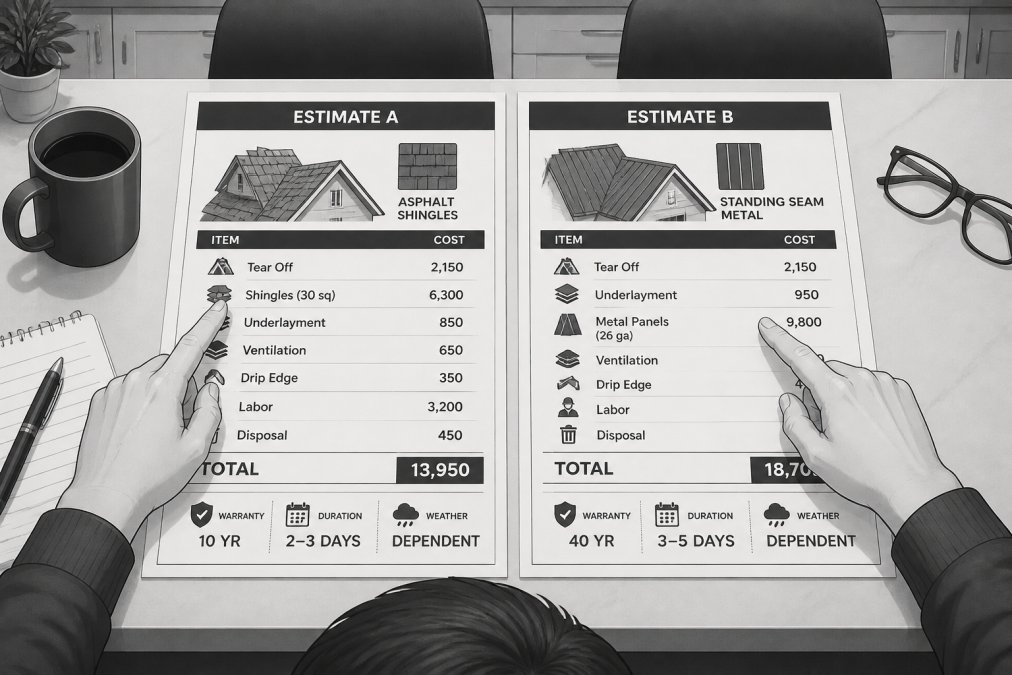
Start by making a simple comparison sheet. Put each contractor in a column and each line item in a row. Then fill in the gaps.
| What to Compare | Why It Matters | What to Look For |
|---|---|---|
| Scope of work | Same job, same items | Tear-off, decking, underlayment listed |
| Material brand and grade | Price follows quality | Named shingle and warranty level |
| Ventilation | Affects roof life | Ridge and intake vent included |
| Warranty | Protects you later | Workmanship years in writing |
| Payment terms | Protects your cash | Deposit size and final payment timing |
If a bid is missing a row, ask the contractor to add it in writing. A quote you cannot compare is a quote you cannot trust.
The Federal Trade Commission's guidance on home improvement contracts is a useful reference for what a solid written agreement should cover before you sign.
A Roof Replacement Estimate Checklist
A complete roof replacement estimate should list tear-off, decking, underlayment, materials, ventilation, cleanup, and warranty in writing. If any of those are missing, the quote is incomplete.
Use this checklist on every bid you receive:
- Tear-off and disposal of the old roof
- Decking inspection and replacement terms
- Underlayment type and coverage
- Shingle or metal brand, grade, and color
- Ridge and intake ventilation
- Flashing around chimneys, vents, and skylights
- Workmanship warranty length in writing
- Manufacturer warranty details
- Payment schedule and deposit amount
- Cleanup and dumpster removal
- Start date and estimated timeline
A bid that checks every box is easier to compare and easier to trust. A bid that skips half of them is a warning sign, no matter how good the price looks.
Questions to Ask a Roofing Contractor Before You Sign
Ask about licensing, insurance, warranty terms, crew status, and payment schedule before you sign anything. The answers tell you more about a contractor than the price does.
Good questions to ask:
- Are you registered, certified, and insured in Texas?
- Will your own crew do the work, or will you subcontract it?
- What does your workmanship warranty cover, and for how long?
- How do you handle storm and hail damage claims?
- What happens if you find damaged decking mid-job?
- How much deposit do you require, and when is the balance due?
The Texas Department of Insurance consumer resources explain how property claims work and what to expect from the process.
A contractor who answers these plainly is a contractor worth considering. One who dodges them is not.
Conclusion
Getting three quotes is not a rule you have to follow. It is a tool, and like any tool, it works best when you use it on the right job. Two detailed bids often beat three vague ones.
If you want a straight answer on your roof without the sales pressure, Roof Repair Company offers free storm and hail damage inspections and instant online pricing in 60 seconds using satellite-based roof measurement. Our team is GAF Master Elite certified, and we provide insurance claim assistance and on-site adjuster meetings. Get started with Roof Repair Company and get a clear, honest estimate for your roof near me in the Katy area.
Frequently Asked Questions
Do I really need three quotes for a roof replacement?
Not always. Three quotes help when you have a detailed scope to compare, such as the same shingle line, underlayment, and decking allowances from every bidder. If the proposals are vague, a third or fourth quote can add confusion instead of clarity. Two well-documented quotes often reveal enough about pricing and approach to make a confident decision, especially when you already know which materials you want.
How many roofing estimates should I get before choosing a contractor?
Two or three is a reasonable range for most homeowners. Two lets you compare value, approach, and comfort level with each contractor. Three gives you a wider pricing picture if the first two are far apart. Beyond three, the returns drop off because you are usually comparing different scopes rather than different prices for the same work. Focus your energy on reading each estimate closely instead of collecting more of them.
What should I compare when reviewing roofing quotes?
Compare the scope, not just the bottom line. Check the shingle brand and product line, underlayment type, decking replacement allowance, ventilation, flashing details, permit handling, disposal, and warranty terms. Ask whether the estimate includes a written summary of findings and whether the contractor will meet your insurance adjuster on site. A roof replacement estimate checklist keeps the comparison apples to apples so a lower number does not quietly hide missing work.
Should I choose the cheapest roofing quote?
The cheapest quote is only a good deal if it covers the same work as the others. A low bid often skips decking replacement, uses a lower-grade shingle, or leaves permit costs out. Ask each contractor to itemize materials and labor so you can see what is included. Price matters, but a written scope, a verifiable certification like GAF Master Elite, and a workmanship warranty matter more for a roof that has to last decades.