Roof Ventilation Repair in Katy: A Homeowner's Guide
Last Updated: November 4, 2026
Quick Summary
Roof ventilation repair restores airflow through a roof's intake and exhaust vents so heat and moisture can escape the attic. It covers clearing blockages, resealing vent flashing, and replacing damaged vents. In Katy's humid climate, this repair is one of the highest-return maintenance items a homeowner can schedule.
- Poor attic airflow can shorten a roof's life by 5 to 10 years.
- Houston-area code requires at least 1 square foot of net-free vent area per 150 square feet of attic floor.
- Roughly half the vent area should be intake at soffits, half exhaust at ridge.
- Keep insulation at least 1 inch back from soffit vents to preserve intake airflow.
- A Katy cost guide lists vent flashing replacement at $250 to $650.
Table of Contents
- Why Roof Ventilation Repair in Katy Matters More Than You Think
- Common Roof Ventilation Problems in Katy Homes
- How a Roof Ventilation Inspection in Katy Pinpoints the Failure
- Step-by-Step Roof Vent Repair: A Safe DIY and Pro Guide
- Attic Ventilation Repair in Katy: Matching the Fix to the Vent Type
- Roof Vent Replacement in Katy: When Repair Stops Being Enough
- What Drives Repair Cost and How Long the Work Takes
- Book Your Free Ventilation Inspection
- Frequently Asked Questions
Why Roof Ventilation Repair in Katy Matters More Than You Think
Poor attic airflow can shorten a roof's life by 5 to 10 years, according to Smith & Sons Roofing's ventilation guidance. That estimate comes from trapped heat and moisture, not storm damage. In Katy, TX, where humid Gulf air sits over every attic from May through September, roof ventilation repair in Katy is one of the highest-return maintenance items a homeowner can schedule.
At Roof Repair Company, we inspect and repair attic ventilation across Greater Houston, and Below, we'll show you how to spot a failing vent, how the 1-per-150 sizing rule works, and when a repair beats a full replacement.
Roof ventilation repair is the process of restoring airflow through a roof's intake and exhaust vents so heat and moisture can escape the attic. It covers clearing blockages, resealing vent flashing, and replacing damaged vents.
Common Roof Ventilation Problems in Katy Homes
Most ventilation failures trace back to two culprits: blocked airflow and compromised flashing. Both are fixable, and both get worse the longer you wait.
Vent Blockage and Crushed Insulation
Insulation blown in too deep is the quiet killer. When it covers soffit vents, intake airflow stops, and the exhaust vents above have nothing to pull. Attic heat then builds until shingles bake from underneath.
Failed Flashing and Water Intrusion
Vent flashing is the metal collar sealing a vent penetration against rain. When it lifts or corrodes, water tracks down the vent shaft into the decking. If you're already chasing a leak, our guide to flat roof repair in Katy: costs, leaks, and next steps covers water intrusion in more depth.
How a Roof Ventilation Inspection in Katy Pinpoints the Failure
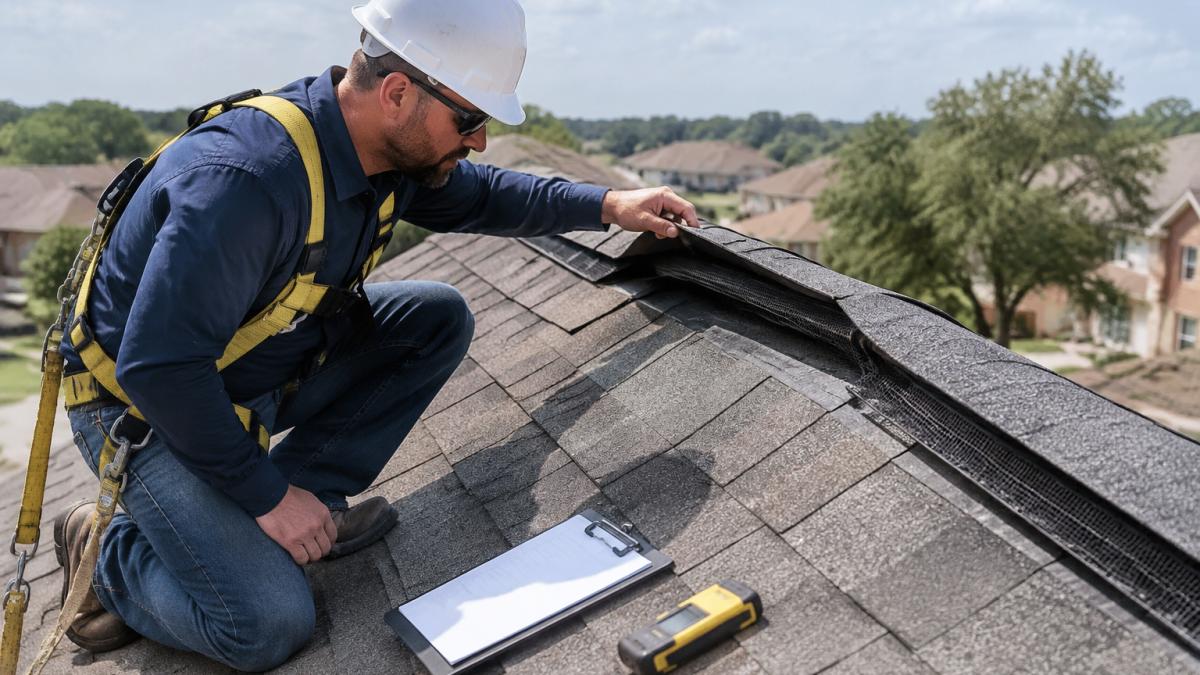
A proper roof ventilation inspection in Katy measures three things: intake area, exhaust area, and whether air actually moves between them. Inspectors check soffit screens for paint and insulation blockage, test ridge and box vents for crushed baffles, and probe flashing seams for moisture. But the harder question is whether the symptom you see is a vent problem at all.
Diagnosing Specific Vent Failures
Work from the symptom backward. Each vent type fails in a recognizable pattern, and the pattern tells you whether the fix is a cleaning, a reseal, or a replacement.
- Loose or cracked vent cover. A box vent lid that lifts or cracks lets rain in and stops pulling air. Check the flange screws first; if the plastic or metal is cracked, the cover is replaced, not patched.
- Damaged flashing. Look for lifted edges, rust streaks, or granules piled at the base of the vent. Flashing that has separated from the shingle course is a water path, not an airflow path.
- Blocked opening. Daylight should be visible at soffits and ridge from inside the attic. If it isn't, insulation, paint, or a crushed baffle is choking the opening.
- Leak at the vent penetration. Water staining on the vent shaft or decking directly downhill of the vent points to flashing. Water staining spread across the decking usually points to a shingle or underlayment failure elsewhere.
Telling a Vent Problem From a Roof Problem
A vent issue usually shows up as heat and humidity with no active drip: the attic runs hot, the second floor stays uncomfortable, and the shingles age from underneath. A roof leak usually shows up as a localized stain, a drip during rain, or a soft spot in the decking. When both appear together, the vent flashing is the first place to probe, because it is the one penetration that is both a water path and an airflow component.
Sizing the System: The 1-per-150 Rule and Airflow Balance
The adopted building code in the Houston area requires at least 1 square foot of net-free ventilating area per 150 square feet of attic floor space, per Optimum Roofing Solutions' code summary.
Airflow balance matters as much as total area. Roughly half the vent area should be intake at the soffits, half exhaust at the ridge. Imbalance is why some attics have plenty of vents and still run hot.
Step-by-Step Roof Vent Repair: A Safe DIY and Pro Guide
Some vent repairs are genuinely DIY. Others are not, and knowing which is which protects both your roof and your warranty. For broader repair guidance, our collection of in-depth roof repair guides walks through the common failure modes.
| Task | Difficulty | Typical Time | DIY or Pro |
|---|---|---|---|
| Clear soffit vent screens | Easy | 30-60 min | DIY |
| Pull back insulation from intake | Easy | 30 min | DIY |
| Replace a box vent cover | Moderate | 1-2 hours | DIY with roof access |
| Reseal vent flashing | Moderate | 1-2 hours | Pro recommended |
| Replace ridge vent | High | 3-4 hours | Pro only |
| Correct undersized ventilation | High | Half day or more | Pro only |
- Inspect from the attic first. Look for daylight at soffits and ridge, and check for rust streaks or dark staining around vent openings.
- Clear intake screens. Brush off paint, dust, and insulation blocking soffit vents. Keep insulation at least 1 inch back from the vent.
- Check baffles. Crushed or fallen rafter baffles choke the soffit-to-ridge path. Straighten or replace them.
- Test exhaust vents. A ridge vent with a clogged screen moves almost no air. Clear or replace the screen.
- Reseal flashing. Lift old sealant, clean the metal, and apply roofing sealant rated for the material. Watch out: sealing over wet or dirty flashing traps moisture and guarantees a repeat leak.
- Verify airflow. After repair, hold a tissue near an intake vent on a mild day. If it doesn't pull, the balance is still off.
Attic Ventilation Repair in Katy: Matching the Fix to the Vent Type
Attic ventilation repair in Katy isn't one job. Each vent type fails differently, and the fix has to match.
- Ridge vent: Fails when the filter screen clogs or the vent sags. Repair means clearing or re-setting the vent, not just adding sealant.
- Soffit vent: Fails when paint, insulation, or debris blocks the screen. Usually a cleaning job.
- Box vent: Fails at the flange and flashing. Often replaced outright.
- Solar attic fan: Fails at the panel, motor, or thermostat. Repair depends on which component died.
Local providers list soffit vents, ridge vents, and solar attic fans among their systems, per All Out Roofing's vent service list. The right fix depends on what's already on your roof.
Roof Vent Replacement in Katy: When Repair Stops Being Enough
Repair stops being enough when the vent area itself is undersized or the decking around the vent has softened. If your attic has one ridge vent and no soffit intake, no amount of patching will fix it. You need a redesigned system.
Replacement also wins when flashing has rusted through, when a powered fan has failed twice, or when storm damage has warped the vent run. A roof inspection from a Cinco Ranch North roofing team can confirm whether the vent is the only problem or a symptom of wider damage.
What Drives Repair Cost and How Long the Work Takes
Cost depends on the vent type, the number of vents, roof pitch, and whether decking needs replacement. A Katy cost guide lists pipe boot or vent flashing replacement at $250 to $650, per Homeowner Henry's repair cost guide. That figure covers flashing replacement specifically, not a full ventilation redesign. Treat it as the floor for a single penetration, not as a ventilation budget.
Cost Factors by Vent Type and Scope
- Soffit vent cleaning or screen replacement. Lowest-cost repair because it is usually reachable from the attic or a low ladder. The driver is access, not materials.
- Box vent cover replacement. Priced by the cover and the flashing kit. A like-for-like swap on a walkable roof is the simplest paid repair.
- Vent flashing reseal or replacement. The $250 to $650 range above applies when the flashing is the only failed component. If surrounding shingles must be lifted and re-laid, the scope grows with the shingle course.
- Ridge vent replacement. Priced by linear feet of ridge and whether the old vent must be removed and the decking cleaned before the new vent is set.
- Powered or solar attic fan repair. Priced by the failed component: motor, thermostat, wiring, or panel. A fan that has failed twice is usually a sign the intake is undersized, and the real cost is the balance correction, not the fan.
What Raises the Price in Katy
Steep pitch, multi-story access, tile or metal roofing that must be lifted carefully, and softened decking all add labor. Storm season adds scheduling pressure: after a hail or wind event, roofers triage active leaks first, and a non-emergency vent repair can wait behind them. A vent repair bundled with an insurance claim for storm damage is priced differently than a standalone maintenance call, so ask which category your job falls into before comparing quotes.
How Long the Work Takes
Timelines are similarly variable. A single box vent swap takes an hour or two. A flashing reseal is a half-day job once the roof is accessed. A full intake-and-exhaust correction can run a half day or more, and a ridge vent replacement on a long ridge can stretch across a full day.
For current prices or a quote, see Roof Repair Company's website.
Book Your Free Ventilation Inspection
If your attic runs hot, your energy bills creep up every summer, or you've spotted rust around a vent, the fix starts with an inspection.
Elyson homeowners can request a free inspection through our Elyson roofing services page, and anyone ready to act can book roof repair in Houston and Katy with written pricing approved before work starts. Backed by GAF Master Elite certification and 1,122 customer reviews.
Frequently Asked Questions
What are the signs that roof ventilation needs repair?
Look for heat buildup in the attic, condensation on rafters or sheathing, rusted fasteners, curled or blistered shingles, and a second-floor that stays hot long after sunset. Inside the attic, check for crushed insulation blocking the soffit vents and torn screens on ridge or box vents. Poor airflow can shorten a roof's life, so these signs are worth acting on before shingle damage spreads.
Should roof vents be repaired or replaced?
Repair fits isolated problems: a cracked pipe boot, loose flashing, a blocked soffit vent, or a failed fan motor. Replacement makes more sense when the vent itself is degraded, when the ventilation system is undersized for the attic, or when storm damage has compromised multiple vents at once. A roof ventilation inspection in Katy should tell you which category you fall into before anyone quotes work.
How often should roof vents be replaced?
Most static vents, ridge vents and soffit vents last as long as the roof covering, so replacement usually lines up with a roof replacement rather than a separate schedule. Powered and solar attic fans have moving parts and typically need attention sooner. Inspect vents annually and after any hail event, since storm damage is the most common reason vent replacement in Katy gets moved up.
Can poor attic ventilation cause roof damage?
Yes. Trapped heat and moisture degrade shingles from underneath, warp sheathing, and feed attic condensation that can drip onto insulation and drywall. Confirm the applicable ventilation requirement with your local authority before sizing a system.
Your attic is either breathing or it isn't, and Katy's humidity punishes the difference. Get a free inspection from Roof Repair Company and find out which one you're dealing with, with written findings you can use for an insurance claim if storm damage is involved.